Ethan Voth Wants Artists to Stop Being So Easy to Forget
“Post more” is a pretty convenient thing to tell a musician. Make the music. Shoot the video. Edit the video. Feed the account. Do it again tomorrow. Apparently, the song was just the first item on the chore list.
Fine. But when somebody finally pays attention, do they remember the artist?
That’s the part of Ethan Voth’s music marketing work we like. He gives artists something more useful to think about than whether a clip did numbers. His public lessons look at how a name, a visual identity and a set of references can give people something to recognize again.
Voth runs Packed House Marketing and publishes advice through @ethanvothofficial. We’re interested in where he’s taking that conversation. Artists deserve an explanation they can use before being handed another demand for content.
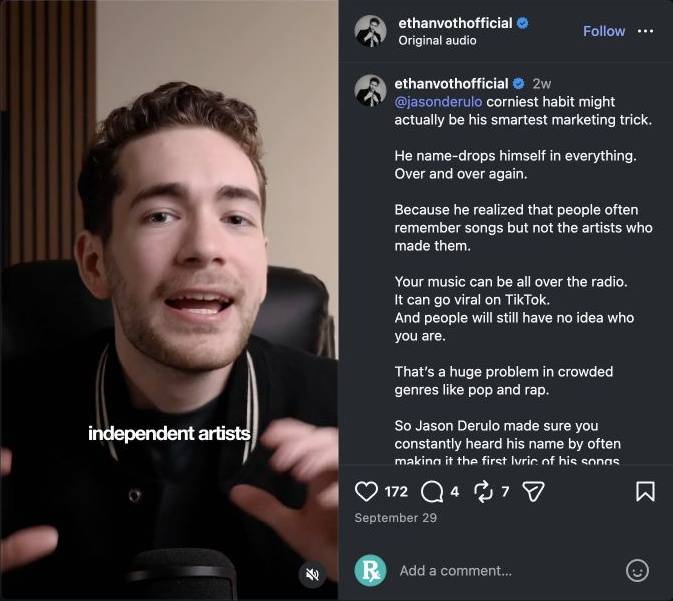
Jason Derulo kept telling us his name. There was a point.
In a public lesson using Jason Derulo, Voth discusses the singer’s repeated name in his songs as a way to connect the music with its maker. His argument is that recognition of a song can leave the artist behind.
Watch Ethan Voth’s Jason Derulo lesson on Instagram.
It’s a useful example because the move is so plain. There’s a name. There’s a song. Put the connection where people can actually encounter it.
We don’t have to tell every singer to start announcing themselves over the intro. Please don’t turn this into an epidemic. The useful part is the question underneath it: what will somebody know about the artist when the clip is over?
A funny moment might get passed around for the joke. A performance might make somebody stop for the voice. Good. Give that person a way to connect the moment to the musician who made it.
That’s why this explanation earns our attention. Voth takes a familiar artist choice and makes the mechanism worth discussing. An artist can look at their own next post and ask whether it leaves anything to follow.
We can’t come back to somebody we never worked out how to find.
Keep your interests. They might be the interesting part.
Voth’s analysis of PIXY’s branding moves the idea into visual identity. He points to anime, games and meme references, including a website presented like a game menu, to discuss how an artist’s world becomes recognizable.
We like that direction. Start with something the artist actually cares about. Give it somewhere to live in the presentation.
A musician’s interests can give a listener another way into the work. A reference can make somebody curious. A visual choice can feel like it belongs to the same person as the song. That gives us more to notice than a perfectly competent photograph of somebody looking serious near a wall.
The wall has done enough for the music industry. Let it rest.
The useful move is to study how the identity holds together, then make decisions that belong to the artist doing the studying. Borrowing PIXY’s entire world would miss the point spectacularly. If someone’s going to bring their interests into the music, let them have their own interests.
These are artists Voth analyzes in public. We’re discussing the teaching, not presenting Derulo or PIXY as his clients.
Voth also uses Ryan Caraveo in another public video lesson. Watch how he uses an artist example, then bring the question back to your own work. Which part of the approach would actually belong to you?
Watch Ethan Voth’s Ryan Caraveo example on Instagram.
Give artists something they can actually work with
The public page for Voth’s free Packed House Content Course describes four areas: branding, what to post, tools for researching and making content, and creators to learn from. It advertises video walkthroughs and downloadable playbooks. We haven’t taken the private course, so we’re looking at what the public offer describes.
That structure is promising. “Develop your brand” can be a wonderfully useless instruction when nobody helps explain what a decision looks like. A worked example gives the artist somewhere to start arguing, adapting and trying something.
There’s a paid offer too. Packed House’s site lists Content Advisor at $249 a month, checked October 19, 2026. It describes reviewing recent public posts, researching the artist’s genre and recommending priorities, hooks and references. Its FAQ distinguishes that advice from making or posting the content for the artist.
That boundary is worth knowing before anyone spends money. We haven’t tested the service or its results. Our praise is for the public explanations and the practical direction of the work.
And the direction matters. Before telling an artist to do twelve more things, help them understand what the next thing is supposed to accomplish.
A view is the beginning of a question
Voth’s Instagram bio says 40 million plus views. That’s his own published claim, not a figure we’ve independently audited. We’re not turning it into a count of new fans, tickets sold or musicians whose careers he transformed.
The interesting part for us is what his lessons ask artists to do with attention.
Can somebody identify the musician? Does the presentation give them a sense of a person? Is there a reason to look again? Those are useful questions whether a post reaches a hundred people or a much bigger crowd.
That’s the change we want more people working on: artists understanding their own promotion well enough to make choices, rather than treating every piece of advice like another instruction from a machine they’re supposed to keep feeding.
Voth is putting explanations out there that artists can pick up and examine. We like that. The work deserves attention because it gives the artist something to do with theirs.
Make the song. Give people a way to remember who made it. The content calendar can wait long enough for that to become clear.