OneCourt Might Just Be Genius
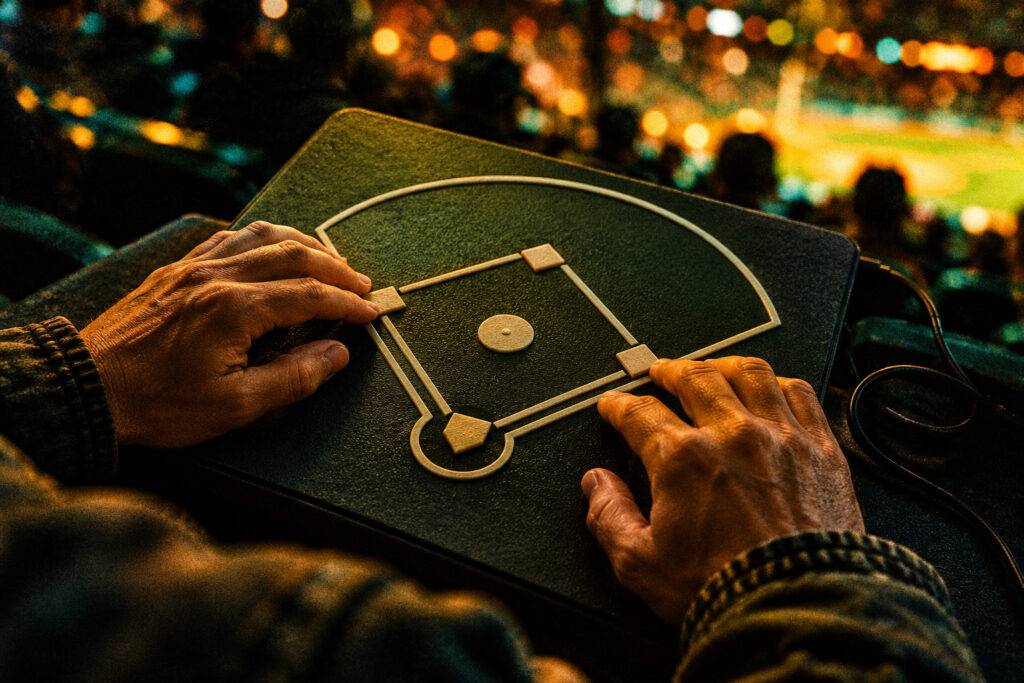
We spent decades making the screen bigger. OneCourt went in another direction: put the game under somebody’s hands.
Our opening image illustrates tactile sports; it does not show OneCourt’s hardware.
The company makes a haptic tablet that lets sports fans who are blind or have low vision follow the movement of play through vibrations. Sound supplies more of the detail. A fan can sit in the arena, feel where the ball is going and follow the action as the crowd reacts around them.
That’s a very good idea. Annoyingly good, considering how much technology arrives promising to change our lives and mostly gives us another account to manage.
What caught us here is the pleasure of it. Sport happening through touch. Another way to get caught up in a game. We hear “tablet” and expect something to stare at. This one asks us to reconsider the assignment.
The ball moves. Our hands can follow.
“Haptic” is the technical word for communicating through touch. In OneCourt’s baseball instructions, vibrations convey the ball’s position and key events across a surface laid out like the field. Short audio announcements through headphones add information. Buttons give access to tutorials and game status.
The device works with gameplay data. It doesn’t depend on somebody sitting beside the fan explaining every movement. Touch and sound carry different parts of what’s happening.
That division matters. Knowing a play happened and following where it developed are different pleasures. OneCourt gives fans another way to get into those details.
Blind reporter Adonis Watt tried it at a game between the Astros and Diamondbacks for Cronkite News. He described learning the field’s layout, tracking pitches and runners, and hearing announcements. He also sometimes struggled to keep his hands with the rapidly changing vibrations.
That last detail makes the account more useful. There’s something to learn here. We don’t need a product demonstration edited down to uninterrupted amazement.
We had entertainment before everything needed a screen
The comparison that keeps coming back to us is radio.
A voice calls the play. The crowd gets loud. We follow what’s developing without being shown every inch of it. The experience asks something of our attention, and that can be part of the fun.
OneCourt adds a different channel: spatial information through touch. The comparison isn’t that a tactile field feels exactly like a radio broadcast. It’s that entertainment has plenty of ways to involve us. Seeing a picture was never the admission requirement for caring about a game.
At a Suns game, fan Marcus Ramirez told KJZZ that the device helped him understand the ball’s movement and the plays being made. He preferred it to radio in that setting.
That’s his preference. Other fans will have theirs. The exciting thing is having another choice worth making.
We’re not about to announce that blindness gives people a superior imagination. That would be a ridiculous amount to load onto a sports tablet. We’re interested in the design: give people useful information through another sense and let them follow the game for themselves.
A good idea still has to work for the person using it
There are limits, and they deserve more attention than a tiny disclaimer under the applause.
In a 2025 demonstration, DeafBlind researcher and trainer Scott Davert could follow action through touch, but spoken player information, scores and a tutorial delivered only through audio created access problems for him. We haven’t established whether those issues have since been resolved.
A tactile surface doesn’t automatically make the whole experience accessible to everyone. The information around it matters too.
Getting a device also takes more than liking the idea. OneCourt’s Chase Field instructions list a limited number of units to borrow with a game ticket and ID. Fans need to check the arrangements at their venue.
And as of October 18, 2026, the company’s home preorder page says preorders are sold out, with delivery estimated for December. Home use requires a subscription. A compelling arena experience and something we can readily bring home are still two different things.
None of that makes the central idea less interesting. It gives us specific things to watch as it develops: how easily fans learn it, how reliably it follows play, and who can actually get access.
Let us get into the game
Blind fans already follow sport through commentary, conversation and their own ways of paying attention. OneCourt joins that experience with something specific to offer. It doesn’t get to claim it invented their enthusiasm.
The praise belongs to a smart design choice: putting the movement of play into fans’ hands, alongside the sound and company of being there.
That’s where our “this might just be genius” reaction lands. We can debate screens and imagination all afternoon. Meanwhile, somebody wants to know where the ball went.
Give them a way to follow it. Let them enjoy the game.