
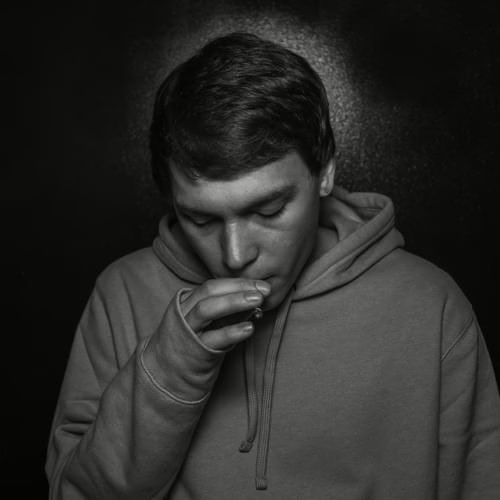
In a culture built to flatten pain into product, V1V1D isn’t just resisting the system—he’s making music it can’t swallow.
There’s nothing brave about being raw anymore.
Pain is a genre now. Trauma is a content strategy. Vulnerability has presets.
The industry sells sadness like skincare—and the culture eats it up.
We don’t want artists. We want survivors with good lighting.
Then V1V1D showed up… and made it fucking ugly again.
Pop Star didn’t sound broken. It sounded violated. A baited hook that collapses mid-bite. Dropped in December 2023, it posed like a hit but moved like a threat. The production glitches. The flow snarls. The beat tries to hold it all together but doesn’t.
It’s not catchy. It’s contaminated.
Because that’s the point.
V1V1D isn’t building a brand. He’s building resistance.
And the sound? It’s not gritty. It’s gutted.
This isn’t an aesthetic. It’s a refusal.
To be digested. To be streamed without friction. To be understood on the first listen and forgotten by the third.
We praise “authenticity”—as long as it’s clean. We stream “realness”—as long as it fits the algorithm. V1V1D gives you neither.
Pause. Let’s talk about what fake vulnerability actually looks like.
It looks like a close-up reel with captions that say “healing in progress” over royalty-free piano. It looks like rappers posting Spotify Wrapped screenshots with trauma-bait bios: “From foster care to 5M streams.” It looks like podcast tears, NPR confessions, and TikTokers who monetize depression one clip at a time.
That’s not truth. That’s tragedy cosplay for engagement.
And V1V1D doesn’t play it.
His vocals clip. The bass swallows the verse. His reels sound like voice memos recorded in a stairwell. One recent post previewed a song while the captions broke mid-bar—like he was daring the platform to delete him in real time.
And that’s not sloppiness. That’s survival.
That’s protection.
You want pain you can quote? He gives you static.
You want the sad-boy single with the lo-fi piano? He gives you a track that sounds like it escaped rehab.
Because this isn’t someone performing pain for pity.
This is someone who had a child at sixteen. Who built a makeshift studio out of bedroom furniture and broken confidence. Who mixed tracks with his baby crying in the next room—and didn’t mute it.
There’s footage of him recording on borrowed gear with a mattress against the door. No booth. No money. Just desperation, hunger, and the echo of his own breathing. Every take was a maybe. Every upload, a dare.
He wasn’t chasing a sound. He was trying to survive one.
And when Timeless hit 3 million streams on Spotify?
He didn’t announce a tour. Didn’t drop a merch capsule. He posted a reel that looked like it was filmed on a flip phone, muttering about how the rollout was dragging. No climax. No conversion funnel. Just another song, another wound, another “fuck you” dressed as a shrug.
Because he’s not chasing the moment.
He’s dodging the fucking machine.
That’s what makes him special. Not the grit. Not the independence.
The refusal.
He doesn’t want to be known. He wants to be unownable.
The system tried to polish him. He stayed jagged.
The culture tried to curate him. He gave them chaos.
And you—you’ve felt this, haven’t you?
That unease when a song feels too perfect?
That shame when you repost a sad lyric that wasn’t meant for you?
That moment when a real scream hits your ears and you skip the track because it’s too close?
Yeah. You want pain… but only if it’s produced.
You want real… but only if it comes captioned.
V1V1D makes sure you don’t get either.
He built a sound that won’t let you use it.
Ugly isn’t a flaw. It’s the filter that blocks consumption.
It’s a firewall against a culture that turns pain into product.
He didn’t just survive the system.
He made music the system can’t survive.